
The Paris Metro Guide for Tourists (Dos, Don’ts & Helpful Tips)
When travelers first arrive in Paris, one of the biggest questions they have is how to get around the city. Should they take taxis? Use rideshare apps? Walk everywhere?
The reality is that the Paris Metro is the easiest and best way to get around the city. Traffic in Paris can be heavy, taxis can get expensive quickly, and many of the city’s famous sights are spread out. The metro connects them all quickly and efficiently.
If you’re visiting Paris, the metro will almost certainly be part of your trip. The good news is that it’s relatively easy to use once you understand a few basics. However, there are also a few dos and don’ts that every traveler should know.
This guide will walk you through how the Paris Metro works, how to avoid common mistakes, and how to travel safely and confidently while exploring the city.
Don’t Be Afraid of the Paris Metro
One of the biggest mistakes tourists make is avoiding the metro because they think it’s confusing or intimidating.
The truth is that the Paris Metro is one of the most extensive and useful subway systems in the world. It has dozens of lines and hundreds of stations, which means that wherever you are in Paris, you are probably only a few minutes away from a metro stop.
Most of the city’s famous attractions are located close to metro stations, including:
- The Louvre
- The Eiffel Tower
- Notre-Dame
- The Arc de Triomphe
- Montmartre
- Musée d’Orsay
Because the network is so extensive, you’re rarely more than a few hundred meters away from a station. Once you get comfortable with it, you’ll find that it’s the fastest way to explore the city.
Understanding Metro Directions
One thing that sometimes confuses visitors is how directions are labeled in the metro.
Instead of saying “northbound” or “southbound,” Paris metro trains are labeled by their final stop on the line.
For example, if you’re looking at Line 1, the signs will show the last station on that line. To make sure you’re going the correct direction, you need to check the final stop listed on the train platform signs.
Most stations also have maps that show every stop along the line, which helps you confirm that your destination is along that route.
A helpful tip is to count the number of stops between your station and your destination. This way, you’ll know when your stop is approaching even if the announcements are difficult to hear or understand.
Buying Metro Tickets and Navigo Cards
There are a few ways to pay for metro rides in Paris, but most visitors will use one of two options.
Navigo Card
One of the most convenient options is the Navigo Easy card.
This is a reusable card that costs about €2 to purchase. Once you have the card, you can load it with individual rides or bundles of tickets.
The advantage of the Navigo card is that you can recharge it easily at ticket machines throughout the metro system. If you plan to return to Paris in the future, you can even keep the card and use it again on your next trip.
Read More: A Perfect 3 Day Paris Itinerary
Paper Tickets
You can also purchase traditional paper tickets at metro stations. However, these are slowly being phased out, and they are easier to lose.
If you use paper tickets, be sure to keep your ticket after entering the station. Occasionally inspectors check tickets, and if you can’t show yours, you could receive a fine.
Using Ticket Machines
Ticket machines are available in every metro station. They typically offer multiple languages, including English, so you don’t need to speak French to buy tickets.
There are usually two types of machines:
- Touchscreen machines
- Older machines with rotating selection wheels
The touchscreen machines tend to be easier to use, although they can sometimes be a bit temperamental.
If you have trouble, you can always visit the ticket service window, where an attendant can help you purchase tickets or recharge your Navigo card.
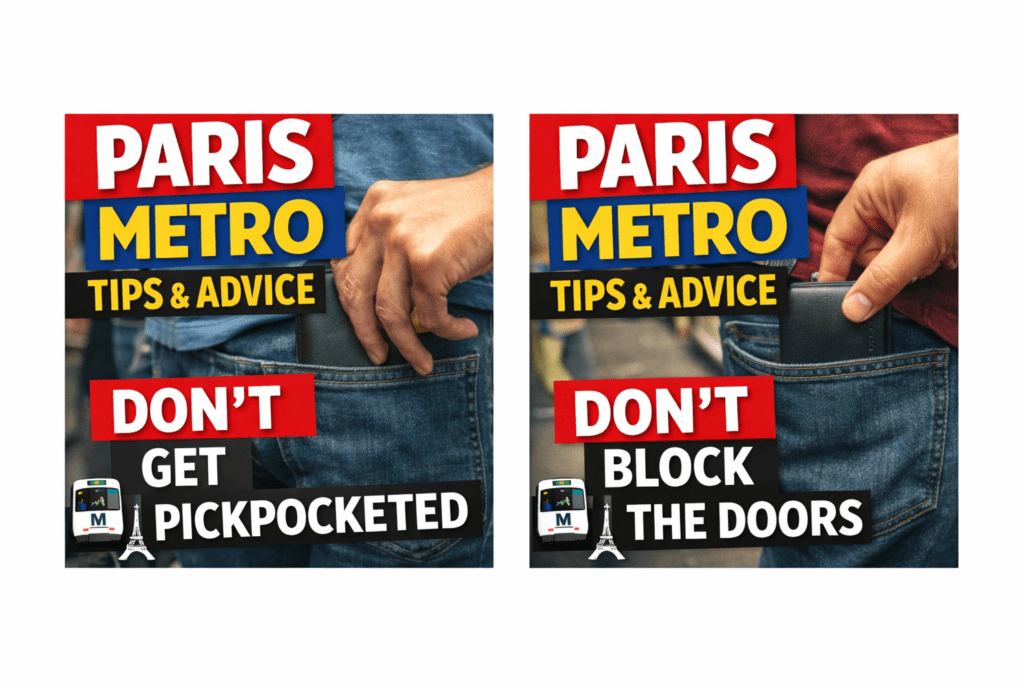
Watch Out for Pickpockets
Like many major cities, Paris has pickpockets who sometimes operate in busy areas of the metro.
Common places where pickpocketing can occur include:
- Ticket gates
- Crowded platforms
- Boarding or exiting trains
Be especially aware of your belongings when passing through ticket barriers or when the train doors are opening and closing.
A few simple precautions can help reduce the risk:
- Keep bags zipped
- Carry backpacks in front of you
- Avoid placing wallets in back pockets
- Stay aware of your surroundings
Most travelers will never experience any problems, but it’s always good to stay alert.
Important French Words to Know
There are two French words that are especially useful when navigating the metro.
Sortie
“Sortie” means exit. When you see signs pointing to “Sortie,” they are directing you to the station exits.
Plan du Quartier
Many stations also display neighborhood maps near the exits. These maps help you determine which exit is closest to your destination.
Choosing the correct exit can save you a lot of walking once you reach street level.
Not Every Station Has Elevators
One thing travelers should know is that many Paris metro stations are quite old.
As a result, not every station has elevators or escalators. Some stations require climbing long staircases to reach the street.
If you have limited mobility or heavy luggage, it’s worth checking your station ahead of time to see what kind of access it offers.
Opening the Train Doors
On some metro trains, the doors do not open automatically.
Instead, you may need to lift a small handle or press a button to open the door when the train stops at a station.
If you’re unsure how to open the door, just watch the passengers around you. Someone will usually show you what to do.
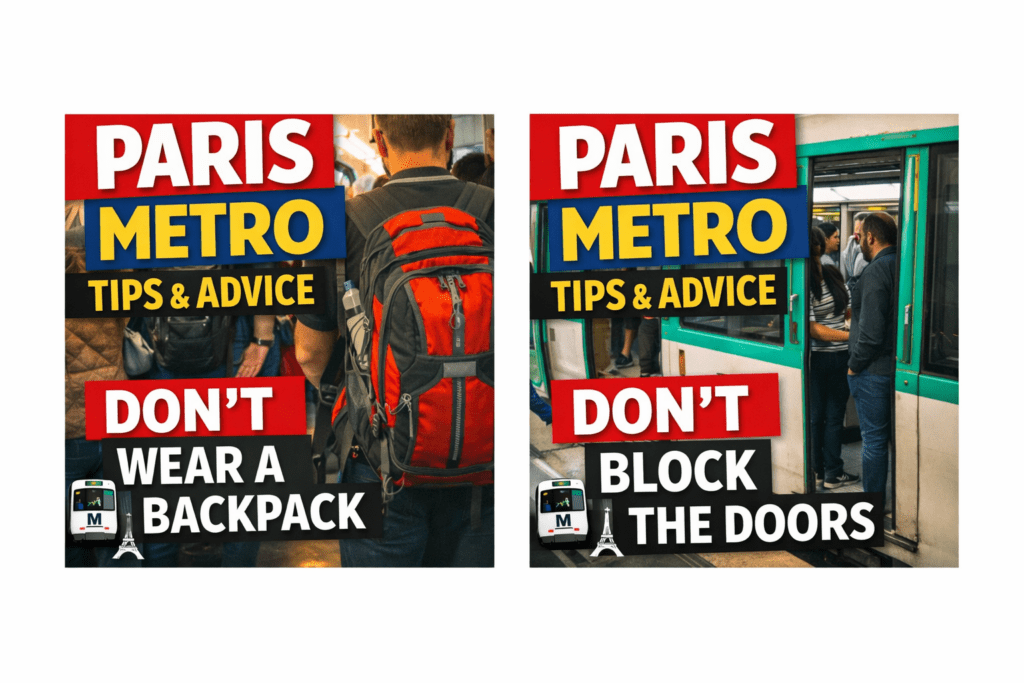
Metro Etiquette: Let People Exit First
One of the most important unwritten rules of the metro is simple:
Let passengers exit the train before you board.
Standing directly in front of the doors makes it difficult for people to leave the train and slows down the boarding process.
Step aside, let passengers exit, and then board once the doorway clears.
Read More: The Most Overrated Sights in Paris
Move Away from the Doors
Another common mistake is standing right next to the train doors after boarding.
Instead, move further into the train so more passengers can board. This helps keep things moving smoothly during busy travel times.
Take Off Your Backpack
If you’re wearing a backpack on a crowded metro train, it’s polite to remove it and hold it in front of you.
This helps prevent accidentally bumping other passengers and also protects your belongings from potential pickpockets.
Avoid Large Suitcases on the Metro
The Paris Metro can get crowded, especially during rush hour.
Because of this, it’s not always ideal for travelers with large suitcases. If you’re heading to the airport, you’ll likely want to take the RER train instead of the metro.
The RER trains have more space for luggage and connect the city to major airports like Charles de Gaulle.
Pay Attention to Your Phone
Another safety tip involves using your phone near the train doors.
Sometimes thieves will grab a phone just as the train doors close and run off the platform.
To avoid this, try not to stand near the doors using your phone when the train is stopped at a station.
Busy Stations to Watch
Some metro stations are larger and busier than others. Stations connected to major train hubs tend to have the most crowds.
Stations like Gare du Nord and Gare de Lyon can be particularly busy, so it’s worth paying extra attention to your belongings when traveling through them.
Trains Run Frequently
One of the nice things about the Paris Metro is how frequently trains run.
In most cases, trains arrive every few minutes. Many stations even display countdown timers showing how long until the next train arrives.
If the train that arrives is extremely crowded, it’s often worth waiting a few minutes for the next one.
Quiet Metro Culture
If you’re used to subways in cities like New York, you may notice something different about the Paris Metro.
It’s generally quieter.
Passengers tend to keep to themselves, listening to music, reading, or simply relaxing during their ride. It’s not a very social environment, and people usually respect each other’s personal space.
Popular Metro Stops for Tourists
One of the biggest advantages of the metro is that it connects directly to many of Paris’s most famous attractions.
For example:
The Louvre
- Louvre–Rivoli (Line 1)
- Palais Royal–Musée du Louvre (Metro and RER)
Musée d’Orsay
- Solférino (Line 12)
- Musée d’Orsay (RER C)
Eiffel Tower
- École Militaire (Line 8)
- Bir-Hakeim (Line 6)
Arc de Triomphe
- Charles de Gaulle–Étoile (Lines 1, 2, 6 and RER)
Notre-Dame Cathedral
- Saint-Michel Notre-Dame (RER C)
- Cité (Line 4)
These stations make it very easy to reach many of the city’s iconic landmarks.
Escalator Etiquette
Another important metro etiquette rule involves escalators.
In Paris, you should stand on the right side of the escalator so that people in a hurry can walk past on the left.
Blocking the left side can frustrate commuters who are trying to catch trains.
Each Person Needs Their Own Ticket
If you’re traveling with family or friends, remember that each person needs their own ticket or Navigo card.
You cannot use the same ticket for multiple passengers when entering the system.
Metro Connections
If you need to transfer between metro lines, you don’t need to buy another ticket as long as you stay within the metro system.
However, be prepared for some walking. Transfers between lines can sometimes involve long underground corridors.
Metro vs. RER
Another thing that can confuse visitors is the difference between the metro and the RER.
The metro lines are numbered, while the RER trains use letters such as A, B, or C.
The RER trains travel longer distances and connect Paris to surrounding suburbs and airports. They also move faster and stop less frequently than metro trains.
Metro Operating Hours
The Paris Metro is not open 24 hours.
Trains typically run:
- 5:30 AM to about 1:00 AM on weekdays
- Until about 2:00 AM on weekends
If you’re planning a very late night out, you may need to take a taxi or rideshare instead.
Take Your Time
For first-time visitors, the Paris Metro can feel overwhelming at first. Large stations with multiple lines can involve long underground walks and lots of signage.
The best advice is simple:
Take your time.
Let the crowds move ahead, read the signs carefully, and follow the directions step by step. After a few rides, you’ll likely find that navigating the metro becomes much easier.
Final Thoughts
The Paris Metro may seem intimidating at first, but it’s actually one of the most useful tools you have for exploring the city.
Once you understand the basics—how to buy tickets, how to find the right direction, and how to follow local etiquette—you’ll find that the metro is an easy, affordable, and efficient way to see Paris.
And before long, you might even start to feel like a local navigating the underground tunnels of one of the world’s most beautiful cities.
So don’t be afraid to hop on the metro during your trip. It might just become one of your favorite parts of visiting Paris.